 Add to Chrome
 Add to Firefox
 Add to Edge
Treatment Effect Estimation with Differentiated Networked Effect on Graph Data
May 27, 2026
Estimating individual treatment effect (ITE) from observational graph data is crucial for decision-making in the fields such as commerce and medicine. This task is challenging due to interference, where individual outcomes can be influenced by the treatments and covariates of their neighbors. Existing methods attempt to model such interference for accurate ITE estimation. However, a critical issue is often overlooked: differentiated networked effect (DNE), an effect caused by local networks consisting of neighbors with varying importance and scales. Capturing DNE is vital; otherwise, we will end up with imprecise ITE estimation due to an erroneous characterization of interference, which can result in misguided decisions. To address this challenge, we propose a novel interference modeling mechanism that incorporates two partial attention mechanisms and a message amplifier. The partial attention mechanisms automatically estimate the importance of different neighbors in contributing to interference, while the message amplifier adjusts the results of the interference modeling mechanism based on the scale of neighbors, all of which enables the model to capture DNE. Experiments on three real-world graphs demonstrate that our methods outperform existing approaches for ITE estimation from graph data, which corroborates the importance of explicitly capturing DNE.

Long-Term Outlier Prediction Through Outlier Score Modeling
Mar 22, 2026This study addresses an important gap in time series outlier detection by proposing a novel problem setting: long-term outlier prediction. Conventional methods primarily focus on immediate detection by identifying deviations from normal patterns. As a result, their applicability is limited when forecasting outlier events far into the future. To overcome this limitation, we propose a simple and unsupervised two-layer method that is independent of specific models. The first layer performs standard outlier detection, and the second layer predicts future outlier scores based on the temporal structure of previously observed outliers. This framework enables not only pointwise detection but also long-term forecasting of outlier likelihoods. Experiments on synthetic datasets show that the proposed method performs well in both detection and prediction tasks. These findings suggest that the method can serve as a strong baseline for future work in outlier detection and forecasting.
MACC: Multi-Agent Collaborative Competition for Scientific Exploration
Mar 04, 2026Scientific discovery still relies heavily on the manual efforts of individual researchers, leading to limited exploration, redundant trials, and reduced reproducibility. Human-participant data analysis competitions generate diverse approaches, yet fluctuations in participation and the lack of independent repetitions show that parallel exploration alone is insufficient for achieving reliable scientific inquiry. As advanced AI agents based on large language models (LLMs) increasingly perform analytical tasks, relying on a single highly capable agent is unlikely to overcome these structural limitations. Recent work has begun to explore how multiple LLM-based agents can collaborate or compete in scientific workflows-a growing trend we refer to as MA4Science. However, most existing MA4Science studies assume that all agents are controlled by a single organizational entity, limiting their ability to examine how institutional mechanisms-such as incentives, information sharing, and reproducibility-shape collective exploration among independently managed agents. To address this gap, we introduce MACC (Multi-Agent Collaborative Competition), an institutional architecture that integrates a blackboard-style shared scientific workspace with incentive mechanisms designed to encourage transparency, reproducibility, and exploration efficiency. MACC provides a testbed for studying how institutional design influences scalable and reliable multi-agent scientific exploration.
Evaluating Cross-Modal Reasoning Ability and Problem Characteristics with Multimodal Item Response Theory
Mar 03, 2026Multimodal Large Language Models (MLLMs) have recently emerged as general architectures capable of reasoning over diverse modalities. Benchmarks for MLLMs should measure their ability for cross-modal integration. However, current benchmarks are filled with shortcut questions, which can be solved using only a single modality, thereby yielding unreliable rankings. For example, in vision-language cases, we can find the correct answer without either the image or the text. These low-quality questions unnecessarily increase the size and computational requirements of benchmarks. We introduce a multi-modal and multidimensional item response theory framework (M3IRT) that extends classical IRT by decomposing both model ability and item difficulty into image-only, text-only, and cross-modal components. M3IRT estimates cross-modal ability of MLLMs and each question's cross-modal difficulty, enabling compact, high-quality subsets that better reflect multimodal reasoning. Across 24 VLMs on three benchmarks, M3IRT prioritizes genuinely cross-modal questions over shortcuts and preserves ranking fidelity even when 50% of items are artificially generated low-quality questions, thereby reducing evaluation cost while improving reliability. M3IRT thus offers a practical tool for assessing cross-modal reasoning and refining multimodal benchmarks.
Adaptive Quality-Diversity Trade-offs for Large-Scale Batch Recommendation
Feb 02, 2026A core research question in recommender systems is to propose batches of highly relevant and diverse items, that is, items personalized to the user's preferences, but which also might get the user out of their comfort zone. This diversity might induce properties of serendipidity and novelty which might increase user engagement or revenue. However, many real-life problems arise in that case: e.g., avoiding to recommend distinct but too similar items to reduce the churn risk, and computational cost for large item libraries, up to millions of items. First, we consider the case when the user feedback model is perfectly observed and known in advance, and introduce an efficient algorithm called B-DivRec combining determinantal point processes and a fuzzy denuding procedure to adjust the degree of item diversity. This helps enforcing a quality-diversity trade-off throughout the user history. Second, we propose an approach to adaptively tailor the quality-diversity trade-off to the user, so that diversity in recommendations can be enhanced if it leads to positive feedback, and vice-versa. Finally, we illustrate the performance and versatility of B-DivRec in the two settings on synthetic and real-life data sets on movie recommendation and drug repurposing.
Unpacking the Implicit Norm Dynamics of Sharpness-Aware Minimization in Tensorized Models
Aug 14, 2025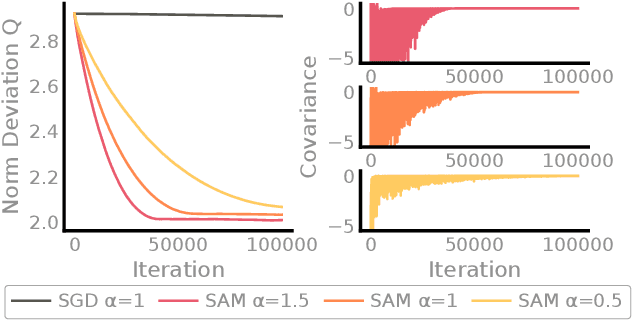
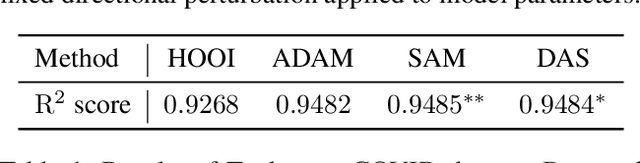
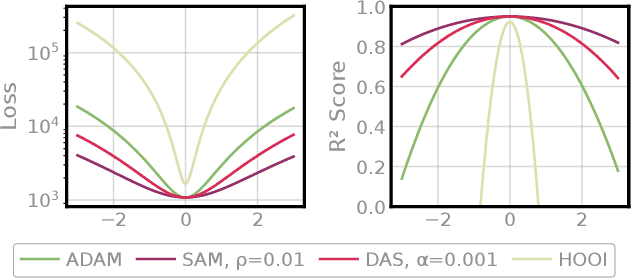
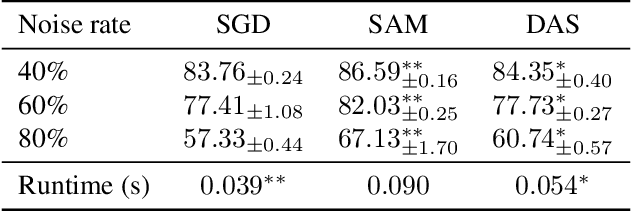
Sharpness-Aware Minimization (SAM) has been proven to be an effective optimization technique for improving generalization in overparameterized models. While prior works have explored the implicit regularization of SAM in simple two-core scale-invariant settings, its behavior in more general tensorized or scale-invariant models remains underexplored. In this work, we leverage scale-invariance to analyze the norm dynamics of SAM in general tensorized models. We introduce the notion of \emph{Norm Deviation} as a global measure of core norm imbalance, and derive its evolution under SAM using gradient flow analysis. We show that SAM's implicit control of Norm Deviation is governed by the covariance between core norms and their gradient magnitudes. Motivated by these findings, we propose a simple yet effective method, \emph{Deviation-Aware Scaling (DAS)}, which explicitly mimics this regularization behavior by scaling core norms in a data-adaptive manner. Our experiments across tensor completion, noisy training, model compression, and parameter-efficient fine-tuning confirm that DAS achieves competitive or improved performance over SAM, while offering reduced computational overhead.
Hierarchical Text Classification Using Black Box Large Language Models
Aug 06, 2025Hierarchical Text Classification (HTC) aims to assign texts to structured label hierarchies; however, it faces challenges due to data scarcity and model complexity. This study explores the feasibility of using black box Large Language Models (LLMs) accessed via APIs for HTC, as an alternative to traditional machine learning methods that require extensive labeled data and computational resources. We evaluate three prompting strategies -- Direct Leaf Label Prediction (DL), Direct Hierarchical Label Prediction (DH), and Top-down Multi-step Hierarchical Label Prediction (TMH) -- in both zero-shot and few-shot settings, comparing the accuracy and cost-effectiveness of these strategies. Experiments on two datasets show that a few-shot setting consistently improves classification accuracy compared to a zero-shot setting. While a traditional machine learning model achieves high accuracy on a dataset with a shallow hierarchy, LLMs, especially DH strategy, tend to outperform the machine learning model on a dataset with a deeper hierarchy. API costs increase significantly due to the higher input tokens required for deeper label hierarchies on DH strategy. These results emphasize the trade-off between accuracy improvement and the computational cost of prompt strategy. These findings highlight the potential of black box LLMs for HTC while underscoring the need to carefully select a prompt strategy to balance performance and cost.
Box-Constrained Softmax Function and Its Application for Post-Hoc Calibration
Jun 12, 2025Controlling the output probabilities of softmax-based models is a common problem in modern machine learning. Although the $\mathrm{Softmax}$ function provides soft control via its temperature parameter, it lacks the ability to enforce hard constraints, such as box constraints, on output probabilities, which can be critical in certain applications requiring reliable and trustworthy models. In this work, we propose the box-constrained softmax ($\mathrm{BCSoftmax}$) function, a novel generalization of the $\mathrm{Softmax}$ function that explicitly enforces lower and upper bounds on output probabilities. While $\mathrm{BCSoftmax}$ is formulated as the solution to a box-constrained optimization problem, we develop an exact and efficient computation algorithm for $\mathrm{BCSoftmax}$. As a key application, we introduce two post-hoc calibration methods based on $\mathrm{BCSoftmax}$. The proposed methods mitigate underconfidence and overconfidence in predictive models by learning the lower and upper bounds of the output probabilities or logits after model training, thereby enhancing reliability in downstream decision-making tasks. We demonstrate the effectiveness of our methods experimentally using the TinyImageNet, CIFAR-100, and 20NewsGroups datasets, achieving improvements in calibration metrics.
Dynamic Feature Selection from Variable Feature Sets Using Features of Features
Mar 12, 2025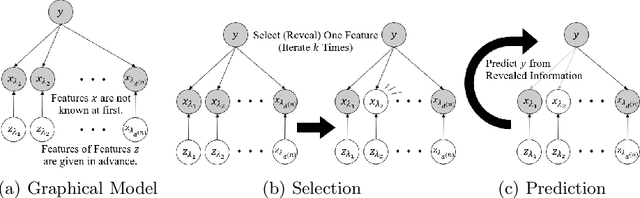
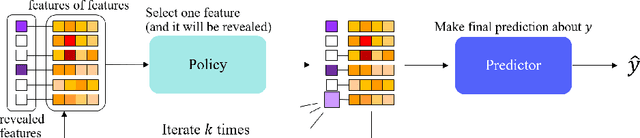
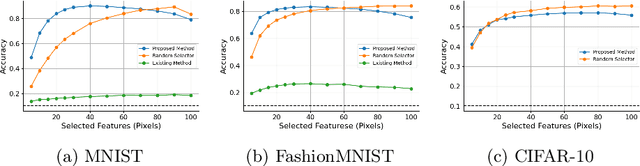
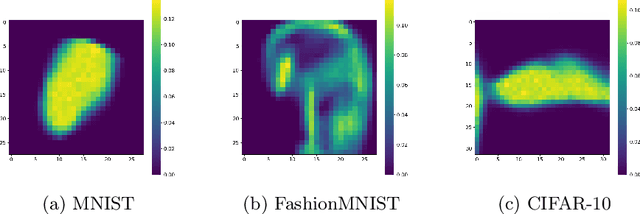
Machine learning models usually assume that a set of feature values used to obtain an output is fixed in advance. However, in many real-world problems, a cost is associated with measuring these features. To address the issue of reducing measurement costs, various methods have been proposed to dynamically select which features to measure, but existing methods assume that the set of measurable features remains constant, which makes them unsuitable for cases where the set of measurable features varies from instance to instance. To overcome this limitation, we define a new problem setting for Dynamic Feature Selection (DFS) with variable feature sets and propose a deep learning method that utilizes prior information about each feature, referred to as ''features of features''. Experimental results on several datasets demonstrate that the proposed method effectively selects features based on the prior information, even when the set of measurable features changes from instance to instance.
Exploring Causes and Mitigation of Hallucinations in Large Vision Language Models
Feb 24, 2025


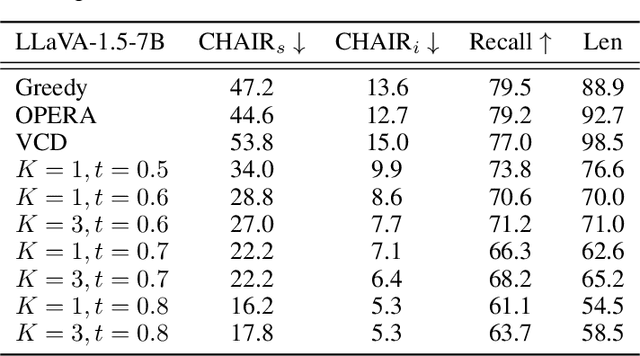
Large Vision-Language Models (LVLMs) integrate image encoders with Large Language Models (LLMs) to process multi-modal inputs and perform complex visual tasks. However, they often generate hallucinations by describing non-existent objects or attributes, compromising their reliability. This study analyzes hallucination patterns in image captioning, showing that not all tokens in the generation process are influenced by image input and that image dependency can serve as a useful signal for hallucination detection. To address this, we develop an automated pipeline to identify hallucinated objects and train a token-level classifier using hidden representations from parallel inference passes-with and without image input. Leveraging this classifier, we introduce a decoding strategy that effectively controls hallucination rates in image captioning at inference time.